

For many organizations, a website RFP feels like a necessary formality. It is the document you create to “do things the right way,” gather comparable proposals, and demonstrate diligence before making a major investment.
The problem is that most website RFPs are quietly designed to fail.
Not because the organization lacks intelligence or effort, but because the RFP itself optimizes for the wrong outcomes. Instead of clarifying the real business problem a website is meant to solve, many RFPs over-specify features, under-specify goals, and unintentionally push agencies toward safe, generic solutions. The result is a selection process that favors compliance over insight and price over effectiveness.
If you want a practical framework for fixing this, you can download our Ideal Website RFP Guide, which walks step-by-step through defining outcomes, aligning stakeholders, and structuring an RFP that invites stronger thinking.
A better RFP does not attempt to design the website in advance. It creates shared understanding around intent, context, and success, giving the right partner space to propose the right solution.
Why Website RFPs So Often Miss the Mark
One of the most common issues with website RFPs is the tendency to confuse activity with strategy. Many documents are filled with long lists of required pages, integrations, content types, and technical features, yet never clearly explain why the website exists or what it needs to accomplish for the organization.
This is not a small oversight. Research from the Standish Group’s CHAOS Report consistently shows that unclear requirements and lack of executive alignment are among the top contributors to project failure and cost overruns. When the “why” is vague, execution drifts.
When success is not clearly defined, agencies are left guessing. Proposals become easy to compare on the surface, but difficult to evaluate in terms of real alignment.
This problem is often compounded by over-specification. When an RFP prescribes solutions too early, it limits the ability of agencies to think critically about the problem. Instead of bringing new ideas or challenging assumptions, vendors are incentivized to simply meet the stated requirements as efficiently as possible.
This dynamic mirrors what Harvard Business Review has written about procurement processes that overemphasize cost control at the expense of innovation. When vendors are evaluated primarily on compliance and price, they behave accordingly. Creativity and strategic thinking are quietly pushed out of the process.
The AI Amplifier
In recent years, another factor has begun accelerating this issue: the growing use of AI to draft RFPs.
AI can be a useful tool for organizing thoughts or identifying common components, but it has a clear blind spot. The RFPs most readily available as reference material tend to come from large enterprises, government agencies, and highly regulated organizations. These documents are built for risk mitigation, compliance, and scale. They are intentionally dense and highly specific.
When smaller or mid-sized organizations use AI to generate or expand an RFP, they often inherit this complexity wholesale. Requirements multiply, scope inflates, and priorities become harder to see.
At the same time, broader research from firms like McKinsey has shown that digital transformations fail at high rates when organizations lack clarity on value creation and measurable outcomes. Adding more documentation does not solve that problem. In many cases, it masks it.
The RFP looks thorough, but it no longer reflects the actual needs of the organization issuing it.
The final outcome is predictable. When goals are vague and requirements are bloated, cost and timeline become the easiest things to compare. Budget, rather than value or fit, becomes the deciding factor by default.
From the agency side, these RFPs often look strikingly similar across industries, even though the underlying business challenges are anything but.
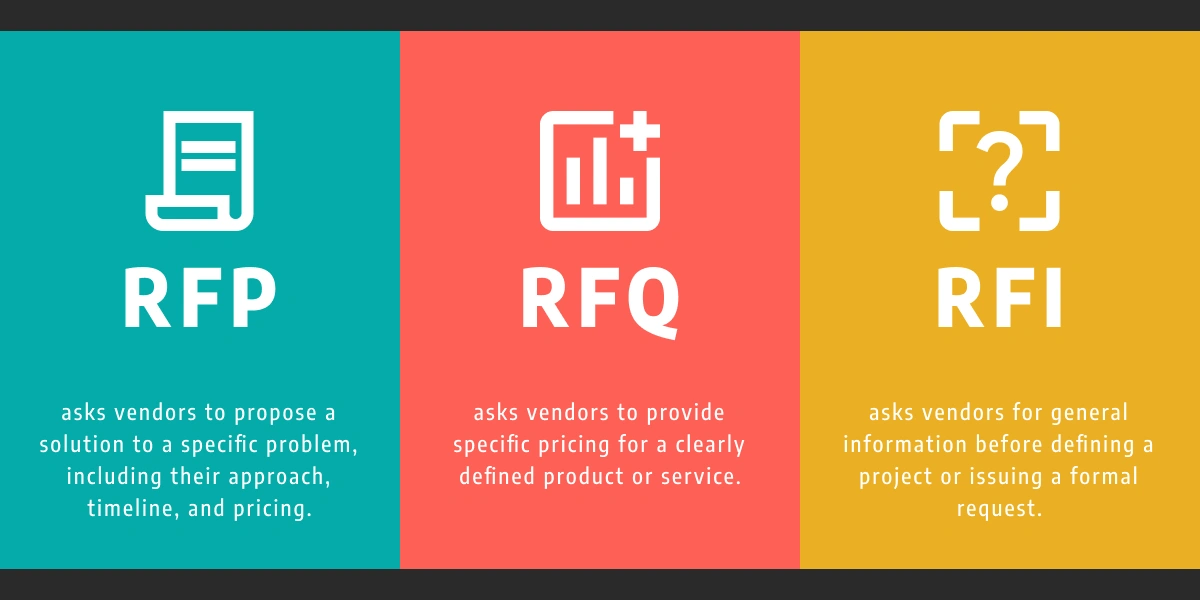
What to Do Instead
A stronger website RFP starts by shifting focus from requirements to context.
Before listing features or deliverables, it should clearly explain the organization’s business goals, audience realities, and the role the website plays within a larger ecosystem. What is working today? What is broken? What pressures or constraints exist internally?
User research should also be part of this framing. According to Nielsen Norman Group, successful digital projects begin with a clear understanding of user needs and behaviors. Without that clarity, teams default to internal assumptions, which rarely reflect real-world usage.
Define Outcomes Before Deliverables
Outcomes should be defined before deliverables.
Rather than leading with page counts or functionality, a good RFP describes what success looks like. That may include:
- Specific performance metrics such as conversion rates or engagement improvements
- Changes in user behavior
- Operational efficiencies for internal teams
- Qualitative improvements such as clarity, accessibility, or scalability
When you define outcomes first, you give agencies a target to design toward, not just a checklist to complete.
This aligns with what strategy researchers call outcome-based planning. When teams anchor decisions to measurable results rather than outputs, they make better trade-offs throughout the project lifecycle.
Invite Strategic Thinking
It is also important to invite strategic thinking, not just execution.
The most valuable partners are not those who simply implement instructions, but those who can challenge assumptions and offer better approaches. An effective RFP asks agencies how they would approach the problem, not just how they would build a predetermined solution.
This is particularly important in website projects, where technology, content, UX, SEO, accessibility, analytics, and governance intersect. No static checklist can fully account for those moving parts.
Be Transparent
Transparency matters as well.
Being explicit about budget ranges, timelines, internal stakeholders, and decision-making criteria leads to stronger proposals and fewer surprises on both sides. The Project Management Institute has repeatedly found that stakeholder alignment and clear governance structures are critical predictors of project success.
When agencies understand the realities they are working within, they can propose solutions that are appropriately scoped and sustainable.
Consider Whether an RFP Is Even Necessary
Finally, it is worth considering whether an RFP is the right tool at all.
In some situations, a discovery engagement or a smaller number of focused conversations can produce better outcomes than a formal, document-heavy process. Particularly for mid-sized organizations, relational due diligence can be more revealing than a highly structured procurement process.
AI can still play a role here, but it should be used thoughtfully. It can help organize information or surface questions, but it should not be the author of your strategy. Human judgment is required to right-size requirements and ensure the RFP reflects the organization’s actual needs, not an abstract ideal.
Bringing It All Together
A website RFP is not simply a procurement document. It is an early strategic moment that sets expectations, defines relationships, and shapes the quality of work that follows.
Research across digital transformation, procurement strategy, and project management points to the same conclusion: clarity of purpose matters more than completeness of documentation.
When organizations move away from prescribing solutions and toward clearly framing problems, they create space for better thinking, stronger partnerships, and more effective websites.
Fixing your RFP will not guarantee success, but it significantly increases the odds that the work ahead is aligned, intentional, and worth the investment.
In the end, the goal of an RFP is not to get more proposals.
It is to get better ones.
Get Better Proposals. Not Just More of Them.
Download our comprehensive guide to creating the perfect website RFP and start to attract partners who think strategically, not just compliantly.

With over a decade of agency and in-house experience, Ben Huizinga is a creative and brand strategist focused on building brands that endure—crafting identities that make meaningful connections and stand the test of time. As Director of Brand and Creative at Young Marketing Consulting, Ben blends hands-on execution with high-level strategic thinking, helping organizations align their vision with the right voice, visuals, and experiences. He is also an experienced website architect, specializing in the development of beautiful, easy-to-use WordPress, Drupal, and Webflow sites that bring brands to life online. His work has shaped leading brands across the sustainability, technology, and nonprofit sectors—including Geothermal Rising, Echo Communications, and Bonterra, one of the world’s largest social good technology companies.
You might also be interested in these related articles:

AI has made content easy to produce, but harder to differentiate. Discover why creativity, judgment, and taste are becoming brands’ most powerful competitive advantages again.

Brand isn’t fluff. It’s one of the most quantifiable levers for growth. Learn how strong brands win more attention, convert more efficiently, and outperform competitors year after year.