
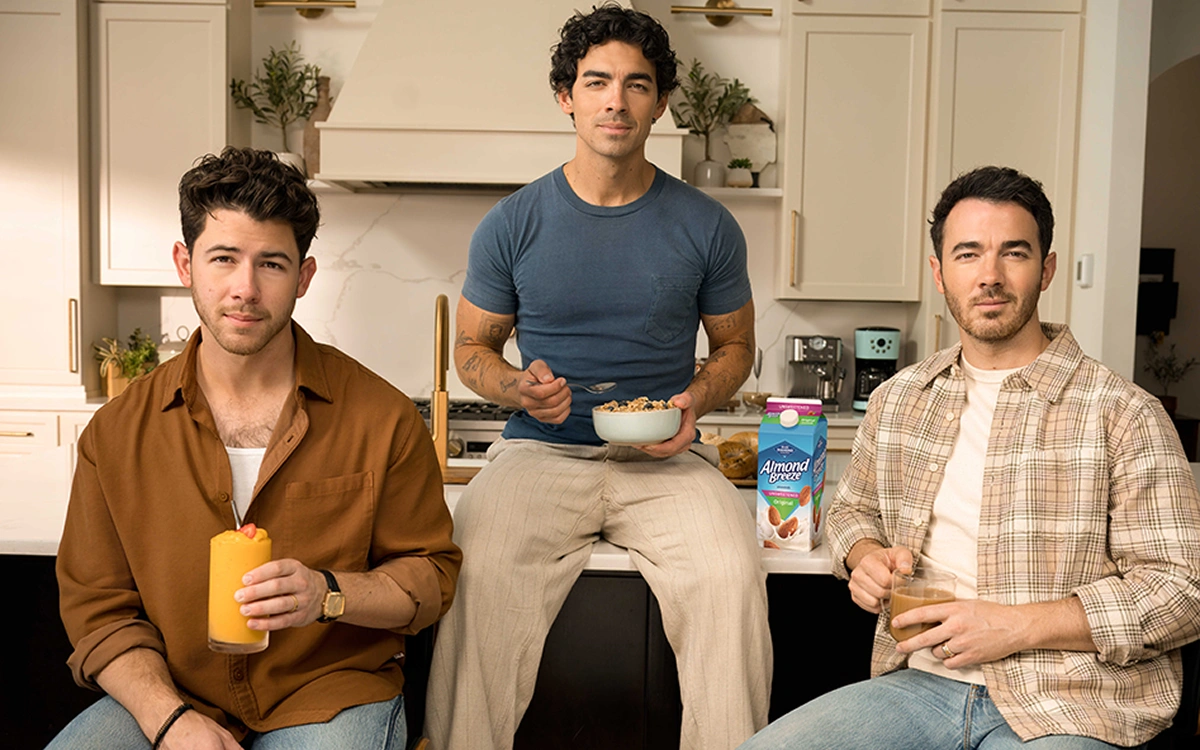
A recent ad from Almond Breeze does something rare in modern advertising: it pokes fun at a cultural moment while quietly saying something true.
The spot brings in the Jonas Brothers to take a playful jab at the flood of AI-generated content now filling feeds, inboxes, and websites. It’s not anti-technology. It’s anti-lazy. And that distinction is exactly why it works.
The ad lands because audiences already recognize the problem. There’s even a name for it now: AI slop — a catch-all term for low-effort, generic content produced at scale. The phrase has entered mainstream conversation precisely because so much of today’s content feels interchangeable. We’ve reached a point where volume is no longer impressive, and speed alone isn’t persuasive.
What makes the Almond Breeze ad interesting isn’t the joke itself. It’s what the joke reveals about where we are, and where brands have an unexpected opportunity.
The Flood Came Fast
The adoption of AI in marketing didn’t happen gradually. It arrived all at once.
According to recent industry surveys, more than 80 percent of marketers now report using AI tools for content creation, with the vast majority planning to increase that usage. Copywriting, social captions, blog drafts, email subject lines, even campaign concepts can now be generated in seconds. From an efficiency standpoint, it’s remarkable.
But efficiency has a side effect. When barriers to creation disappear, content multiplies rapidly. Channels fill up. Timelines blur together. And the average piece of content carries less weight than it did even a few years ago.
This isn’t a new pattern. Every technological leap that reduces friction creates an initial surge in output. What’s different this time is the speed and sameness. AI doesn’t just make content faster. It makes it statistically average. And when everyone uses the same tools trained on the same data, the results start to converge.
The Problem Isn’t AI. It’s Indifference.
Most marketers already understand this intuitively. Despite widespread AI adoption, nearly half of brands still report that human editing and review remain essential to their content workflows. AI can generate drafts, but it rarely delivers finished work without intervention.
That gap is telling.
AI is very good at structure. It’s good at tone approximation. It’s good at pattern recognition. What it struggles with is judgment: knowing what not to say, where to push, where to hold back, and when a joke lands versus when it feels forced.
This is why so much AI content feels technically fine but emotionally hollow. There’s no clear point of view. No risk. No taste. And audiences feel that immediately, even if they can’t articulate why.
As several creative leaders have noted publicly, AI excels at execution, not intention. It can help answer a brief, but it can’t decide whether the brief is worth answering in the first place.
Why This Is an Opportunity, Not a Threat
Paradoxically, the more content AI produces, the more valuable real creativity becomes.
When everything looks polished, polish stops being a differentiator. When everyone can publish, discernment becomes the advantage. The brands that stand out aren’t the ones producing the most content. They’re the ones producing content that feels deliberate.
Research increasingly supports this. Teams that combine AI tools with strong human direction consistently outperform AI-only workflows. The highest returns come not from automation alone, but from hybrid approaches where AI accelerates production and humans shape meaning.
This shifts the role of creatives in an important way. The value isn’t just in making things anymore. It’s in deciding what to make, why it matters, and how it should sound in a crowded environment.
Taste, restraint, humor, and cultural awareness — these aren’t soft skills. They’re strategic assets.
The Brands That Will Win Will Direct AI, Not Worship It
The most effective brands won’t reject AI, and they won’t blindly embrace it either. They’ll treat it as what it is: a powerful tool that still needs leadership.
Used well, AI can speed up iteration, explore variations, and remove friction from early drafts. Used poorly, it becomes a content firehose with no filter.
Industry research from content marketing organizations makes this clear. AI accelerates workflows, but it does not replace strategy, narrative, or brand voice. Those decisions still belong to humans.
In practice, this means AI should behave like a junior assistant, not a creative director. It can help get ideas on the page, but it shouldn’t decide which ideas deserve to exist.
What This Means for Creative Teams and Leaders
As AI takes over more of the mechanical work, the skills that matter most are shifting upward.
Creative leadership, editorial judgment, and brand stewardship are becoming more important, not less. Clear briefs matter more because AI will faithfully execute whatever you give it, good or bad. Constraints matter more because without them, outputs flatten.
Workforce trends reflect this shift. Demand continues to grow for roles that combine creativity with strategy: creative directors, brand leads, content strategists, and editors who can shape direction rather than just produce assets.
The work hasn’t disappeared. It’s changed altitude.
Why the Almond Breeze Ad Gets It Right
The Almond Breeze ad works because it understands the moment it’s responding to. It doesn’t lecture. It doesn’t moralize. It simply points out something the audience already feels and does so with humor and clarity.
It’s not rejecting AI. It’s rejecting indifference.
That’s the lesson brands should take from it.
Creativity Isn’t Going Away. It’s Getting Rarer.
AI has raised the floor for content creation. Anyone can generate something passable. But raising the ceiling still requires human thought.
In a world where content is abundant, meaning becomes scarce. Brands that invest in real ideas, strong points of view, and creative leadership will stand out faster, not slower.
If everyone can generate content, creativity becomes the advantage again.
And that’s a good thing.
Additional Reading on AI Slop
- More than 20% of videos shown to new YouTube users are ‘AI slop’, study finds (The Guardian)
- AI Slop Has Turned Social Media Into an Antisocial Wasteland (CNET)
- Why Equinox Leaned on AI Slop in Its New Year’s Ad Campaign (New York Times)
- YouTube Music is getting flooded with AI slop, and paid users are fuming (Android Authority)

With over a decade of agency and in-house experience, Ben Huizinga is a creative and brand strategist focused on building brands that endure—crafting identities that make meaningful connections and stand the test of time. As Director of Brand and Creative at Young Marketing Consulting, Ben blends hands-on execution with high-level strategic thinking, helping organizations align their vision with the right voice, visuals, and experiences. He is also an experienced website architect, specializing in the development of beautiful, easy-to-use WordPress, Drupal, and Webflow sites that bring brands to life online. His work has shaped leading brands across the sustainability, technology, and nonprofit sectors—including Geothermal Rising, Echo Communications, and Bonterra, one of the world’s largest social good technology companies.
You might also be interested in these related articles:

A bloated RFP doesn’t guarantee a better website. It often guarantees safer, more generic proposals. Learn how to shift from feature checklists to clear outcomes and attract partners who think strategically, not just compliantly.

Brand isn’t fluff. It’s one of the most quantifiable levers for growth. Learn how strong brands win more attention, convert more efficiently, and outperform competitors year after year.