
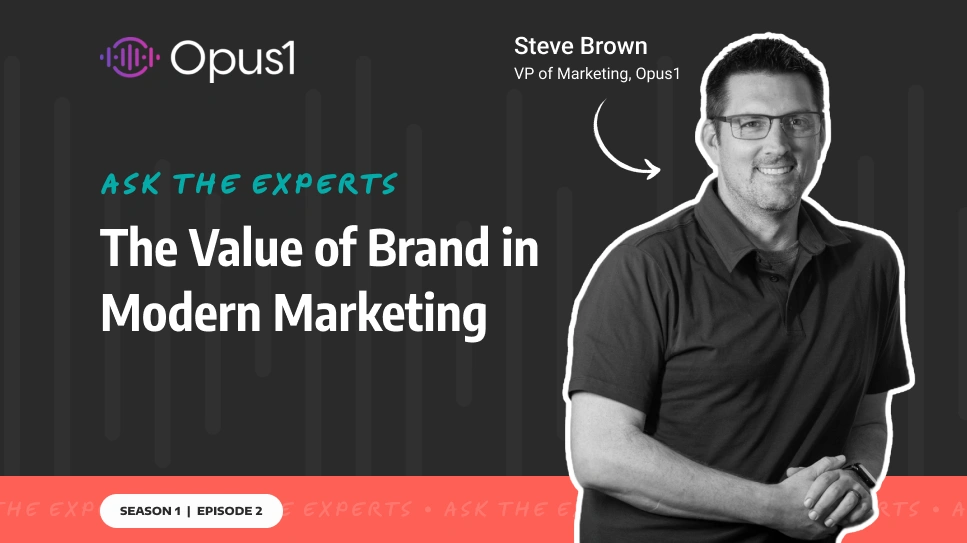
Great marketing often starts with listening. As Steve Brown explains, marketers are ultimately storytellers: people who listen closely to customers, translate what they learn internally, and then bring those stories back to the market in ways that resonate.
In this edition of Ask the Experts, Steve shares how that philosophy has shaped his career and his work leading marketing at Opus1. From the lessons he learned cold-calling executives early in his career to the strategic thinking behind Opus1’s recent rebrand, this conversation explores how brand, trust, and customer insight work together to drive growth.
Getting Started
Q: For anyone meeting you for the first time, how do you usually explain what you do and how you got here?
I coach youth sports, and I like to explain this the same way I explain it to my kids: I’m a storyteller. I listen closely to customers and bring their stories back to my team so we understand what they need and why it matters. Then I help tell customers the story of what we’ve built and how it makes their work and their businesses better.
How did I get here? At 10 years old, I declared that I wanted an MBA and a career in business, without really knowing what “business” was. I was influenced by my father, a CEO with a finance background, who spoke often of great marketing. In college and graduate school, I naturally gravitated toward marketing because it let me pair creativity with strategy and gave shape to what had been an otherwise fuzzy interest in business.
Q: Looking back, were there any early experiences that really shaped how you think about marketing today?
My first job out of college (right after the dot-com bust and 9/11) was as a sales associate cold-calling Fortune 500 executives. I was terrible at it and, wow, the stuff executives would say without fear of being recorded like most sales calls today would shock you. But I digress, I struggled with rejection and didn’t yet have the confidence for that kind of role. I think about that version of myself often when developing marketing strategies. I ask what would have helped: better enablement, stronger assets, clearer stories, and prospects who already knew who we were. Marketing can and should provide all of that.
Q: What drew you to Opus1, and why did this role feel like the right next step for you?
Marketing isn’t a single, monolithic discipline but rather it’s a collection of specialties that converge at a certain level. I came up through product marketing, and what I’ve always loved most about it is the close connection to both the product and the customer. I learned that it helps when you genuinely care about what you’re building and who you’re building it for. As a drummer who took lessons throughout my childhood and spent much of my twenties using any extra money to see shows at the 9:30 Club in Washington, DC, Opus1 was a natural fit. We help music and dance schools grow so they can educate more musicians and dancers. How cool of a mission is that?
Q: When you joined Opus1, it was clear that the brand needed to evolve. What stood out to you right away about how the company was showing up in the market?
I swore I’d never be that marketing leader who comes in, puts everything on hold, and spends months on a new brand. But that’s exactly what I did… without the hold part, of course.
Our old brand was fine. It was working (sorta). But to quote the great Roy Kent of Ted Lasso fame, “don’t you dare settle for fine”. Our colors weren’t particularly bold. Our logo wasn’t unique. Our designs were inconsistent. Again, all fine things early in your growth. But I see myself as a long-term builder, focused on creating value that scales. If we wanted to lead and shape a new category, we needed something that would separate us from competitors in a lasting way.
Q: If the need for a brand update was obvious, what was less obvious? What did you need to learn before you could act on it?
Customer sentiment was the deciding factor. Whether I personally wanted to change the brand didn’t really matter. I needed to know the change would work for our customers and that I wasn’t taking something away they cared about. After talking with several customers, the message was consistent: “It’s fine.” There was acceptance, but no real attachment. Yet in the same breadth, they would go on and on about how much they loved our solutions and our team. That was enough clarity for me. We needed a brand identity that matched their affinity for Opus1.
Brand as a Strategic Lever
Q: Many organizations treat brand as something that sits alongside marketing, not something that shapes it. How do you think about the relationship between brand and marketing?
I often tell folks at Opus1 that the brand only works if we make it real. The brand is a promise, but the real thing is our team and our product. Because so many people here are music educators, there’s a deep commitment to the mission, and you can see it in what we build and how we treat customers. Our new logo captures that energy. It looks like a soundwave and even hides a smile, which reflects our desire to delight. When people feel that, even subconsciously, marketing becomes a lot easier.
Q: From your perspective, what does a strong brand actually make easier for a marketing team?
I’m going to get very tactical for a moment. Marketers work with the brand all day, every day. We create content, design web pages, write emails, place ads, and more. When colors, fonts, and design elements are easy to work with, teams can move much faster. Unusual fonts require more testing. Color palettes with clashing or vibrating colors demand closer review. Overly complex imagery makes it harder and slower to build attractive pages.
There are, of course, many other benefits of a strong brand, including better campaign performance, stronger awareness, and clearer differentiation. But here, I want to acknowledge the people who live inside the brand system every single day and depend on it to do their best work efficiently.
Q: Rebrands fail far more often than they succeed. From your perspective, what factors need to be in place for a rebrand to actually work?
It starts with needing a reason to rebrand. Too many marketing executives rebrand to leave their mark because it’s the most obvious and visible thing to do. Then when customers see it, they ask, “but why”? The failure is that you never made it about the customer.
When you make rebranding about the customer and seek their input, you’re more likely to understand what they value and what they don’t. Take something away that they care about, and they’ll let you hear it (just ask Cracker Barrel or Gap).
Q: In Opus1’s case, what enabled you and the team to move decisively rather than getting stuck in endless debate or incremental change?
Early on, we agreed that this would not be a committee-driven process. With the support of our CEO and leadership team, I had the autonomy to make decisions and keep things moving. Because the work was informed by deep customer and business understanding, we felt confident in that approach. The goal was to avoid ending up with a bland, Frankenstein-style brand shaped by compromise.
What Changed After the Rebrand
Q: After the rebrand, what changed first in how Opus1 approached marketing?
This is a tough one for me to answer since the brand change happened fairly soon after I joined Opus1. What I can say is that we leaned all the way in. We redid the website, refreshed our collateral, updated videos, and rethought our campaigns. Everything felt more connected as a result.
Q: Where has brand had the most noticeable impact so far, whether externally with customers or internally with the team?
The most noticeable impact has been on customers and employees. We hear fewer “it’s fine” responses and many more “I love it.” Some employees even shared that they disliked the old brand but had never said so before. Adoption was immediate, from email signatures to Zoom backgrounds and presentations. There was no resistance. People wanted to represent the new brand. Those consistent touchpoints compound over time, as positive customer experiences become closely associated with the brand, building trust and affinity we can carry forward.
Brand, Trust & the Buyer Journey
Q: Opus1 sells to owners who are deeply invested in their schools and communities. How does brand influence trust in that kind of buying decision?
Opus1 is an end-to-end management solution to run music and dance schools. Owners of these schools are trusting us to help them run virtually every aspect of their dream, which also happens to be a business. Because we offer so many features, the brand truly becomes a proxy for the whole solution.
We hear how our customers talk about Opus1 and can see – in referrals, retention rates and upsells – that we’ve earned that trust. But the thing about trust is that you need to constantly re-earn it. And our brand is one of the tools we use to do that.
Q: Where do you see brand reducing friction across the buyer journey?
When as a buyer you know a brand is considered the best in a category, you’re less concerned about the nuance and want to get right to realizing the value. We’ve got the reviews, the testimonials, and the reputation for delivering, which is why many of our sales conversations are short. We’ve heard “everyone I’ve talked to has said that Opus1 is the best”.
Lessons & Advice
Q: Looking back, what’s one lesson from the rebrand that you think other marketing leaders underestimate?
It’s hard to kill off an old brand. The longer you’ve been around, the more places you need to replace it. I know this is a tactical answer, but even today, many months past our rebrand, we’re still finding corners of the business where the old brand and messaging are hanging out.
Also, you have to constantly re-educate people on your brand. Most people outside (and even inside) marketing don’t read your brand voice every day. Remind them. Educate new employees. And never miss an opportunity that it’s their responsibility to help our brand earn trust in the customer’s mind.
Q: What advice would you give to a marketing leader who knows their brand is holding them back but is struggling to make the case internally?
Get help and talk to customers.
This is a hard case to make because it is rarely a pure ROI decision. Engage an agency or two to assess your brand. Even though they may favor change, their insights can help you build a stronger, more informed case.
Support your case with customer feedback. Survey customers and prospects, compare your brand to competitors, and gather reactions. If the same feedback keeps surfacing, such as a competitor being seen as more modern, that is powerful validation for your case.
In Closing
Q: As you look ahead, how do you see the role of brand evolving at Opus1 and in marketing more broadly?
Like most things marketing, brand is moving closer to revenue. As acquisition costs rise and channels fragment, brands are doing more of the work that performance marketing used to do alone. Strong brands lower friction, increase conversion rates, shorten sales cycles, and improve retention. That makes brand less of a nice-to-have and more of a growth lever.
Brand is also becoming a shared responsibility. It is not owned solely by marketing. Product, customer success, sales, and leadership all shape the brand through their actions. Marketing’s role is to articulate, align, and amplify that reality.

With over a decade of agency and in-house experience, Ben Huizinga is a creative and brand strategist focused on building brands that endure—crafting identities that make meaningful connections and stand the test of time. As Director of Brand and Creative at Young Marketing Consulting, Ben blends hands-on execution with high-level strategic thinking, helping organizations align their vision with the right voice, visuals, and experiences. He is also an experienced website architect, specializing in the development of beautiful, easy-to-use WordPress, Drupal, and Webflow sites that bring brands to life online. His work has shaped leading brands across the sustainability, technology, and nonprofit sectors—including Geothermal Rising, Echo Communications, and Bonterra, one of the world’s largest social good technology companies.
You might also be interested in these related articles:
Ask the Expert is a new interview series spotlighting marketing leaders navigating mission-driven and membership-based organizations. In our first conversation, AMCP’s Erica Klinger shares a candid perspective on balancing advocacy, retention, and trust, and on using data and AI to strengthen clarity, alignment, and long-term impact.