

Overview: What’s Changed and What to Do Now
Digital marketing is undergoing its biggest shift since mobile search. Search behavior is changing, attribution is eroding, and traffic is dropping even when rankings remain stable. AI-generated answers are increasingly sitting between your brand and your audience.
Recent comparative traffic analysis from Ahrefs shows that while Google still drives the overwhelming majority of web traffic, AI assistants like ChatGPT are steadily gaining share. AI currently represents only a fraction of total referral traffic — but its growth signals a structural shift in how information is discovered and surfaced.
This has led many teams to the wrong conclusion: SEO must be dead. It isn’t. But the way most organizations approach content absolutely is.
We’ve outlined this shift in detail in our post, Marketing in the Age of AI: How to Stay Performant in a Post-Search World, which breaks down how AI-driven discovery is reshaping visibility, traffic, and performance expectations.
So what’s actually happening, why are clicks falling across industries, and how does content need to evolve to stay visible in an AI-driven discovery landscape?
The Structural Shift in Search Behavior
Search has shifted from navigation (clicking links) to resolution (getting answers instantly). Independent research confirms that generative AI didn’t create zero-click behavior—it accelerated it.
- ChatGPT already owns anywhere from 5-19% of the current search market.
- More than 60% of informational searches now end without a click
- When AI summaries appear, users are nearly 50% less likely to click a standard search result.
- Content-heavy pages commonly see 40–60% bounce rates, even when they rank well, because users get the information they need instantly.
Pew also found that AI summaries aren’t just reducing clicks—they are often fully satisfying user intent before a website becomes necessary.
Reddit Confirms the Same Pattern
Across marketing, SEO, and AI communities, one recurring theme keeps showing up: “My rankings are stable. Impressions are high. But traffic has fallen off a cliff.”
The visibility is still there. The clicks are not.
Why Rankings No Longer Tell the Full Story
Traditional SEO assumed a linear path: Rank → Click → Learn → Convert
But in an AI-resolved search environment, that sequence collapses.
Teams now commonly report:
- Rankings holding steady
- Impressions increasing
- Clicks declining
- Attribution becoming less reliable
This isn’t a tracking issue. It’s a shift in how discovery happens.
AI search systems (ChatGPT, Google AI Overviews, Perplexity, Gemini) now resolve more informational and comparative queries directly inside the interface. Users get:
- Summaries
- Comparisons
- Definitions
- Recommendations
…without ever leaving the platform.
In this environment:
- Visibility doesn’t guarantee traffic
- Authority doesn’t guarantee clicks
- Impact doesn’t equal sessions
The core question is no longer “How does this page rank?” It’s: “Is this content being used inside AI answers—whether or not someone clicks?”
How AI Systems Actually Use Content
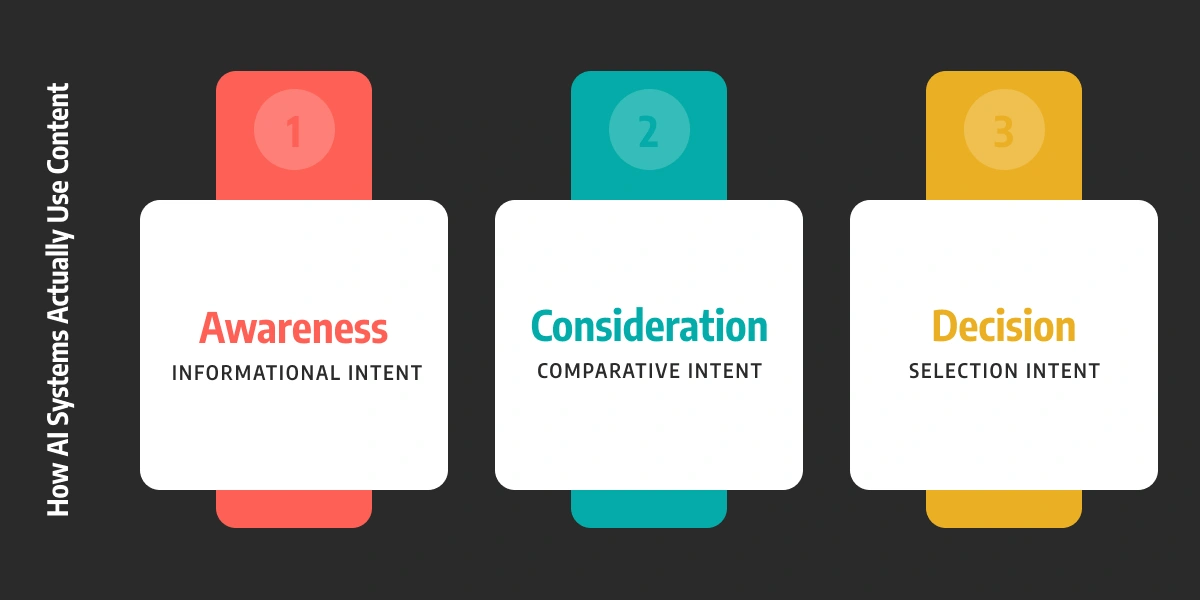
Generative AI systems don’t rank pages. They pull patterns from multiple sources to produce a response that feels accurate, complete, and useful. Based on observable behavior, documentation from OpenAI and Google, and retrieval patterns in Perplexity and Gemini, a few consistent stages emerge.
Awareness-Stage Queries (Informational Intent)
For broad “what is…” or “how does…” questions, AI systems tend to lean on:
- Educational resources (Wikipedia, universities, technical explainers)
- Structured definitions and clean explanations
- Content that breaks concepts down clearly
- Community discussions, including Reddit, when real-world examples help clarify the idea
Review and comparison sites only show up when the query has early commercial intent (e.g., “types of,” “options for”). For purely informational queries, definitions and explainers dominate.
Consideration-Stage Queries (Comparative Intent)
As soon as a user begins evaluating options, AI models shift toward sources that clarify differences:
- Review sites and comparison guides
- Analyst and media coverage
- Brand-owned content that explains differentiators
- User-generated comparisons and third-party evaluations
The model is looking for tradeoffs, feature differences, pros and cons, and high-level summaries that can be recombined.
Decision-Stage Queries (Selection Intent)
Once the user signals a decision is near, AI systems rely heavily on:
- Frameworks and step-by-step decision paths
- Criteria lists (“what to consider…”)
- >Use cases and scenario-based guidance
- Implementation advice and expected outcomes
This is where clearly structured, expert-level content has the most influence. Models prefer content that helps someone choose, not just understand.
The Unifying Pattern
Across all stages, AI systems consistently prefer:
- Clarity
- Logical structure
- Demonstrated expertise
- Internal consistency and interconnected topics
Keyword density and content volume matter far less than they once did. What matters is whether your content ecosystem is easy for AI systems to understand and connect.
Why YouTube Now Matters More Than Traditional SEO Signals
Recent AI search analysis shows that YouTube mentions are the strongest predictor of AI visibility—outperforming Domain Rating, backlinks, and other traditional SEO signals.
This reflects how AI systems learn. Google and OpenAI train heavily on YouTube content, and AI-generated answers often rely on ideas reinforced through video—even when no video is cited.
The takeaway is not “make more videos,” but that AI rewards concepts reinforced across formats. Visibility now comes from consistent ideas across text, video, and community—not just ranked pages.
Independent research now confirms what many teams are experiencing firsthand. Traditional authority signals like Domain Rating and backlinks show only weak correlation with AI visibility, while clarity, freshness, and cross-surface reinforcement matter far more.
The problem isn’t declining effort. It’s a misaligned strategy.
Why Many Content Strategies Are Breaking
The majority of SEO-driven content produced over the last decade was built to earn a click, not to explain a concept, support a decision, or serve as structured knowledge that a model can reuse.
Common failure points include:
- Content that answers a keyword but not the actual intent
- Pages that exist in isolation
- Over-reliance on Google for discovery
- Thin or generic posts made for publishing quotas
- Weak internal linking and inconsistent terminology
- No authoritative point of view or original insight
- Content optimized for algorithms, not people or AI systems
As one Reddit user put it: “My old SEO content used to drive 20k/month. Now it barely moves. Is SEO over?”
No.The strategy is. AI didn’t break SEO. It exposed which content was fragile.
What to Do Now: A Practical Shift in Strategy
Below is a clear table outlining how today’s strategy needs to evolve and what actions to take.
Practical Takeaways to Modernize Your Content Strategy
| Old Mindset | New Mindset | What to Do Now |
|---|---|---|
| Publish posts to rank for keywords | Build interconnected topic clusters to match how people search and how AI reconstructs intent. | Map core themes, consolidate overlaps, and link every piece to its cluster |
| Write for the click | Write content that works even without the click | Add summary sections, definitions, comparisons, and decision support |
| Optimize pages individually | Optimize the whole ecosystem | Strengthen internal linking and ensure coherence across related topics |
| Focus on publishing volume | Focus on clarity, depth, and structure | Improve formatting, add schema, tighten explanations, add POV |
| Treat AI as a side channel | Treat AI as a primary discovery surface | Rewrite content for clear retrieval: headings, definitions, examples |
| Measure success by sessions | Measure success by visibility, usefulness, and influence | Track SERP features, impressions, and relevance to AI summaries |
| Depend on Google referrals | Diversify how people discover you | Build content that surfaces in AI search, social discovery, and forums |
Can Legacy Content Still Work?
Absolutely—but most of it needs to be restructured.
Most existing content benefits from:
- Clean, answer-first summaries
- Stronger definitions and clearer explanations
- Explicit intent alignment
- Consolidation of overlapping posts
- Better internal linking
- Thoughtful POV and original insight
- Schema markup or structured data
The opportunity isn’t to publish more. It’s to reorganize what you already have so AI systems can understand it, trust it, and reuse it.
The brands that win in 2025 and beyond will be the ones who understand how their audiences learn, compare, and decide—even when no click happens.
The Bottom Line
SEO isn’t dead. Traffic isn’t the whole story. Rankings aren’t the sole indicator of success.
We’re entering an era where content is:
- Infrastructure for AI systems
- A credibility signal across topic clusters
- A decision-support tool
- A brand memory builder long before someone visits your site
Content must work before, during, and without the click.
The brands that succeed will build structured, interconnected, authoritative content ecosystems—not just more blog posts.
If your content strategy can’t survive without traffic, the problem isn’t SEO. It’s the strategy.

Marketer, Board Director, and Lifelong student. Inspired by humble leadership, teamwork, and a well-told story. Alison Napolitano is a seasoned leader with over 17 years of experience driving brand growth and revenue in the tech sector. With a background spanning agencies, EdTech, and Cybersecurity, AI Security she brings proven expertise in product, growth, content, brand, paid media, SEO, and integrated marketing strategies. As Director of Digital Marketing at Young Marketing Consulting, Alison crafts strategies that fuel growth and elevate brands. Previously, she led impactful marketing initiatives at CodeSecure, an application security testing and cybersecurity firm, and 2U Inc., a global leader in education technology, and honed her skills at agencies like Domain7 (now Versett).
You might also be interested in these related articles:

AI search is rewriting how people find information, but not everyone is ready for the shift. Learn why the brands that win will be the ones that stay grounded, create real clarity, and avoid the noise surrounding GEO.

Authority and Conversion Content might be the only framework your B2B team needs in 2025. Here’s why marketers are leaning in.