
The rules of digital marketing are changing faster than at any point in the last decade. Search behavior, social media distribution, attribution models, and even what it means to “rank” are all being reshaped by AI’s generative search.
This post distills the key takeaways from our recent presentation, Marketing in the Age of AI, into a practical framework for modern marketers navigating declining organic reach, AI‑driven discovery, and a fragmented information ecosystem.
How is AI Search Shifting the Digital Marketing Landscape?
First, we need to address a Google-sized elephant in the room: Google’s share of search is likely declining.
A recent National Bureau of Economic Research on ChatGPT usage gives us a few higlights:
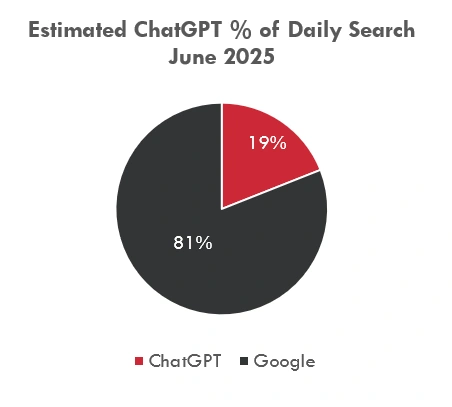
- ChatGPT was serving 2.6 billion messages a day as of June 2025. Google was serving ~13.7 billion searches as of Jan 2025.
- The service categorizes almost a quarter (24.4%) of those messages as “information seeking” (meaning people using it like a search engine)
- So, with the caveat that this data is ONLY from consumer plans, we could assume that ChatGPT already owns anywhere from 5-19% of the current search market.
While ChatGPT user volume may be plateauing (perhaps because of Google’s Gemini and AI search releases), it’s clear that the service continues to have a massive impact on the digital landscape.
But that’s not all. Several additional forces are converging to reduce traditional organic performance:
- AI is changing how users consume information, leading to the rise of “zero-click” searches that don’t provide any return on marketing-created content.
- Core quality updates continue to favor authority and depth, raising the bar for visibility.
- Many sites are seeing material drops in organic clicks, even when rankings appear stable.
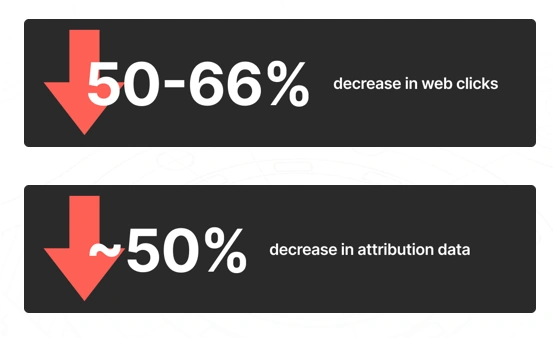
The upshot? Organizations are seeing 50-66% declines in click volume, and 50% decreases in attribution data.
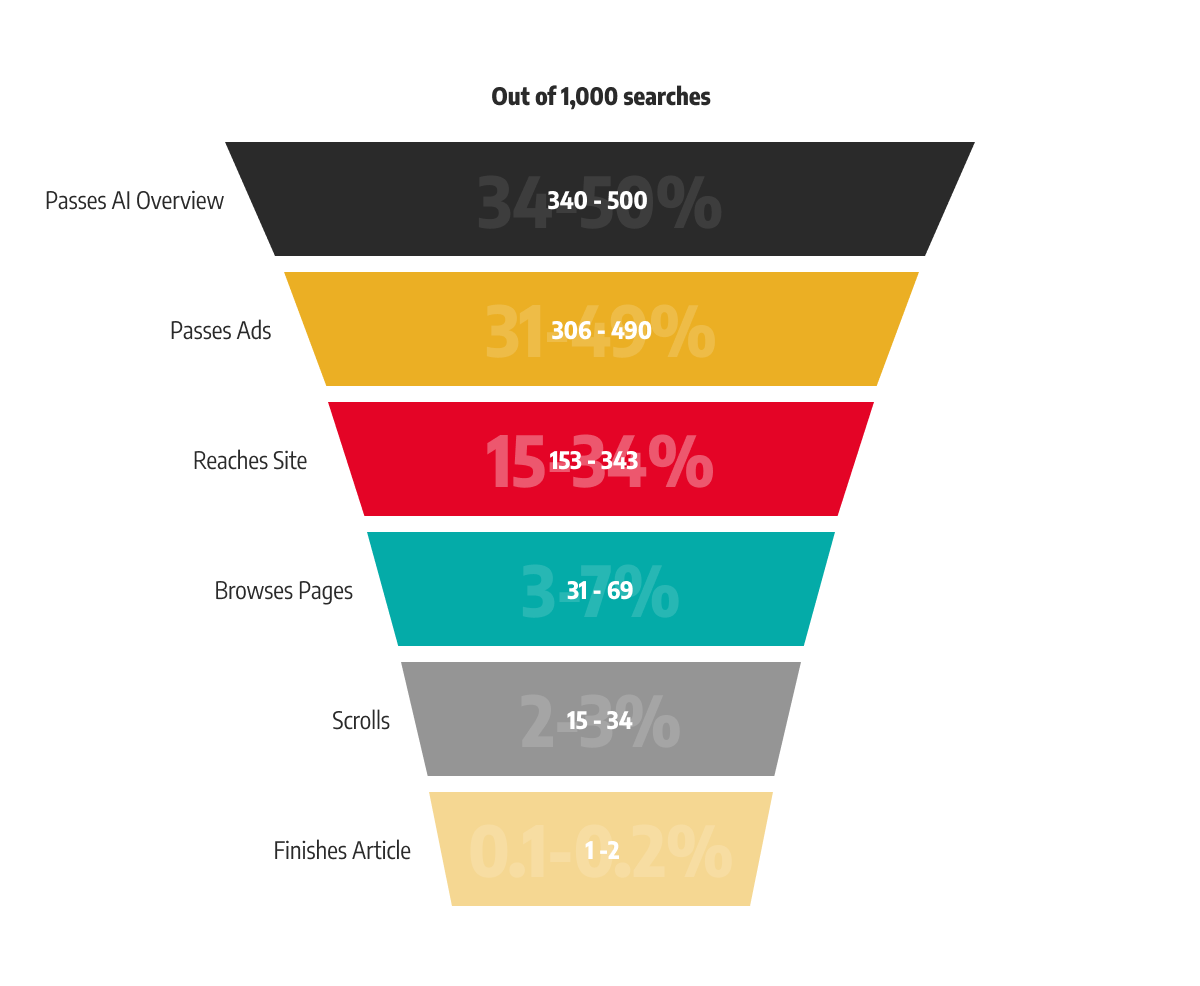
User behavior across the full content funnel tells a sobering story:
- 50–66% of users consume AI overviews and stop
- 2–10% of the remaining searchers click sponsored results
- 30–50% of people who arrive on your site bounce quickly
- ~20% of those who remain consume some content
- ~50% of those readers actually scroll
- ~5% read to the end of an article
Here’s what those numbers look like. Out of 1,000 searches, you’ll be lucky to get 2 people to read to the end of your content:
How Should Your Content Marketing Evolve for GEO?
The first thing you’ll need to do is think outside of Google, which no longer sits at the top of the awareness funnel.
Back in its heyday, Google’s research found that the typical B2B searcher visited 10 sites before going to a brand’s site. This same behavior occurs today, but modern discovery now happens across a distributed information funnel that feeds into AI responses. And these AI responses will change based on the user’s perceived intent.
So you’ll need to do two things for effective content marketing:
- Maintain a strong presence and engaging content across as many third-party sites as possible.
- Continue your traditional SEO activities
Why the second item? Because the sites at the top of the AI visibility pyramid are also the top of the traditional search rankings.
How Do AI Models Categorize Search Intent?
You could write many books on this subject, but for our purposes, the classic AIDA (Awareness → Interest → Desire → Action) funnel model still applies. What changes is where the models look for input at these different stages.
Awareness Searches
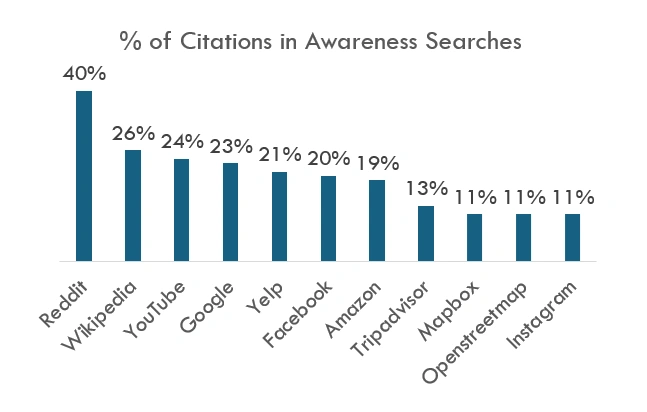
At the top of the funnel, the Visual Capitalist’s research on AI awareness search results found that AI models most commonly cite Reddit in awareness searches.
Intent Searches
However, when it comes to purchase intent-driven searches, AI models switch to return results from sites in the following (rough) order:
- Product recommendations
- Customer reviews
- Media/publications
- Video platforms
- Directories
- Brand sites
- B2B marketplaces
- Ecommerce sites
- Corporate blogs
- Influencers
- Communities & forums
- Deal sites
- Niche media
- Local listings
- References
- Social networks
- Academia
- Government
- Standards bodies
What you might note here is that the “awareness” sites fall much further down the list when someone gets serious about shopping.
How Can You Improve Your AI Search Rank?
To optimize your content marketing for the AI Search era, you’ve got three core goals to address:
- Establish visibility across fragmented decision paths
- Build credibility in the places buyers trust
- Create content designed for humans and AI systems
To do so, follow these steps:
- Focus on quality (and volume)
- Shift your paid focus
- Ensure clean structured data
- Think in nodes, not pages or keywords
Let’s address each in turn.
Quality Beats Volume….
One way to think of AI tools is that they are starved for credibility. The worst thing in the world would be for users to abandon a tool because it gave poor results. To that end, in our experience AI systems reward content that demonstrates:
- Real expertise
- Research, data, and citations
- Practical, tactical guidance
- Unique perspectives
- Clear comparisons and tradeoffs
In other words, AI is looking for quality content. And not the kind that’s generated by an AI model.
…But Volume Conveys Authority (so shift your paid focus)
Paradoxically though, volume still matters. Without an objective way to measure content quality, AI algorithms default to traffic and engagement to identify the “best” content. So you’ll need to push spend upstream into awareness channels within your niche to generate that traffic and engagement. That means investment in content on Reddit, YouTube, Meta, and other “entertainment” channels to try and break through the noise wherever you can.
As well, you’ll likely benefit from tightening keyword‑driven paid efforts around high‑intent conversion terms instead of higher-funnel plays.
And a final note here, AI advertising is coming. Be ready to test ChatGPT and other AI‑native ad placements as soon as they mature
Ensure Clean Structured Data
To be visible to AI systems, content must be machine‑readable as well as human‑useful. This means you’ll want to have:
- Clear information architecture
- Consistent internal linking
- Strong entity and topical signals
- Clean structured data for your content and product
You’ll want to review everything against schema.org‘s documentation, and also prepare for the OpenAI Agentic commerce protocol to become more widespread.
Think in Nodes, Not Pages
AI models break down inputs and data using computation nodes that are specialized for particular tasks or categorizations. These nodes will do things like infer a user’s search intent, organize content into categories related to that intent, and identify whether something is a practical “how-to” or a strategic idea.
This node-based thinking is the key to GEO.
Instead of asking, “How does this page rank?” or “What keywords should I use”, ask:
- What decision does this content support?
- Which nodes in the information funnel does it feed?
- How does it connect to reviews, comparisons, and real‑world validation?
The more dense of a network of content designed to support buyer understanding you can create, the better your chance for AI search visibility.
Summing It All Up
The brands that win won’t be the ones who chase algorithms—they’ll be the ones who understand how modern buyers learn, compare, and decide. We hope this piece has been a good guide to help you along that path.
If you’d like help translating these ideas into a concrete content, media, or measurement strategy, we’re always happy to talk.

A performance-driven marketing strategist with twenty years of experience growing international brands and organizations, Tim Young spent time at the Corporate Executive Board (now Gartner) and the Entrepreneurs' Organization before founding Young Marketing Consulting in 2013.
His areas of expertise include brand growth and identity development; lead generation and conversion; search engine optimization (SEO); customer satisfaction evaluation and improvement; customer segmentation and CRM work; ROI analysis and improvement; market research; and product development.
You might also be interested in these related articles:

AI search is rewriting how people find information, but not everyone is ready for the shift. Learn why the brands that win will be the ones that stay grounded, create real clarity, and avoid the noise surrounding GEO.

AI-driven search is rewriting the rules of marketing — with half of users stopping at the overview and only 5% finishing an article. Learn how to adapt your SEO, email, and social strategy before your reach evaporates.