
We appear to be entering an era of brands built on profit, not value. While AI search and algorithmic focus consolidates digital experiences and makes brand discovery harder, many brands appear to be trying to force growth as opposed to organically meeting the needs of their customers.
So today we’re going to take some time and understand what exactly a value proposition is, and why it will matter more than ever in the new era of digital homogeneity.
What is a Value Proposition?
Your value proposition quickly and clearly communicates what a potential customer will receive from you.
Customers make purchase decisions based on what they expect to receive in return, and want to get the most “value” for the least amount of effort possible (usually measured in time or money).
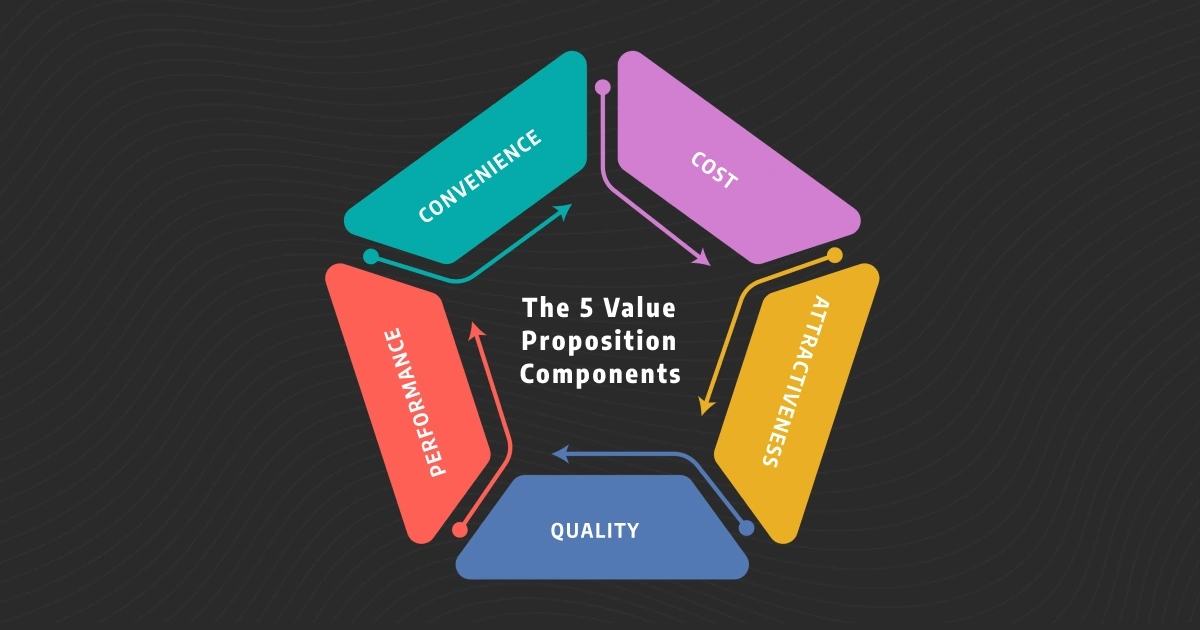
However, different customers define value in different ways. After spending a significant amount of time pouring through the academic research on value drivers and purchase motivations, my assessment is that the five components below are by far the most common purchase decision criteria.
Understanding the Components of a Value Proposition
- Convenience: you’re saving your audience time or effort and generally making it as easy as possible to solve their problem.
- Cost: you’re either saving your audience money, or giving them the best value for their dollar.
- Attractiveness: you’re making your audience more desirable in some way.
- Quality/Trust: you’re giving your audience strong reliability and dependability.
- Performance: you’re enabling your audience to achieve something they could not have otherwise done, or helping them meet a certain standard.
Let’s dig into each component a bit further.

Convenience
How easy is it to purchase your solution? How much effort will an individual need to make to do so? How much time or effort will you save them? Your answers to these questions fall under the concept of convenience.
Convenience is frequently the most influential purchase decision factor due to how much of a role it plays at the customer’s final decision point. The more friction your audience must overcome to access your offering (and receive their benefit), the less likely they will be to convert.
We can define convenience in several ways, depending on the medium:
- Online: how difficult is it for users to register and receive information?
- Location: Are your locations easy to find, or are they an hour away from anything and not found on Google Maps?
- Speed: can you deliver more quickly than Amazon, or will your package take weeks to arrive?
Your audience will almost always choose the most convenient option unless external pressure from something like regulation or availability tilts the scales. People’s desire to receive something as quickly and easily as possible is the reason why Amazon has grown to become such a force, and why Google drops the search rankings of web pages that load fractions of a second more slowly.
Which makes the convenience aspect of your value proposition incredibly important. Brands in high demand, or those that emphasize luxury, scarcity, or elite quality, can still draw customers. Everyone else needs to be as accessible as possible.
Cost
When an individual thinks of cost, they’re considering the question “how significant is this pain point for me, and how much am I willing to spend to solve it”?
Outside of convenience, cost is the next most influential component of your value proposition because the majority of a market will typically flow to the lowest-cost solution that provides acceptable quality.
However, you have a bit more flexibility in how you position your value proposition around cost:
- Lowest cost: your solution can compete to be the lowest-cost provider, along the lines of Wal-Mart.
- Cost savings: your solution saves cost in another area.
- Quality: solutions making claims of higher quality or performance can often carry a cost premium. Think about a brand like Patagonia, which is known for its sustainable sourcing, responsible disposal of used clothing, and repair services, but not low prices.
- Luxury: at the high end of the pricing spectrum, luxury brands differentiate themselves with high prices that are in themselves a status symbol.
There are a few other factors to know about cost:
- Your audience rarely makes a pure sticker decision. They will weigh the other factors of your value proposition (quality, convenience, etc.) alongside your price to see if they’re getting the best value possible. For example, people are generally willing to pay more for convenience, but at a certain price point that desire will fade.
- Cost is individually defined. A price point that seems expensive to one customer may not even register to another.
- Cost does not have to be monetary. Cost can play on our innate fear of losing something as well, through messaging related to missed opportunity costs or the consequences of inaction (as with life insurance offers).

Attractiveness
Everyone (including businesses) wants to feel attractive and in demand. But what defines attractiveness?
The first quality that comes to mind is likely physical: clear skin, toned bodies, and luxuriant hair. That’s certainly one aspect of attractiveness, but you can emphasize any number of other factors to appeal to attractiveness:
- Health: If you’ve ever seen a pharmaceutical ad, you’ve seen a health appeal. We all want to feel as good as we can and live as long as we can, and health appeals that show a carefree individual out for a walk with their spouse can be very attractive to individuals struggling with chronic issues.
- Wealth: wealth is attractive because it puts an individual in control of their own destiny and potentially allows them to achieve their dreams.
- Public recognition: The opportunity for public recognition is often a motivator. In a B2B context, the brand awareness and track record of a solution often plays a significant role in decision making.
- Power: Power appeals offer a sense of regaining control over an issue.
- Expertise: Building expertise can make an individual attractive, because it encourages others to approach them for help and makes the individual feel wanted. This particular appeal shows up often in B2B contexts.
- Aesthetics: The aesthetics of inanimate objects can be used to highlight attractiveness. Curb appeal, design lines on a car, fabric thread count and more all emphasize the attractiveness of what’s being sold, under the assumption that their effects will spread to the owner by extension.
How much weight does your target audience place on any of the criteria above? If they use your solution, how much more attractive will they become?

Quality/Trust
The question a quality/trust focused value proposition answers is “do I get what I paid for?”
Customers tend to think of quality as a measure of the durability of a physical good like a car, while trust applies more for a service, such as the garage that fixed your car. In both cases, however, a quality/trust value proposition emphasizes reliability and dependability. It also plays a role in defining customer price expectations.
If your solution carries a high price point, your customers will have certain expectations for factors like durability, reliability, and customer service. These expectations tend to lower in correlation with price, but low-cost products that provide great quality can quickly outshine competitors.
As I write this in the immediate post-COVID era, consumers everywhere are decrying a quality decline in everything from food to clothes to furniture that the media has dubbed “enshittification”. These complaints primarily stem from the fact that prices for most goods have risen to levels that have in the very recent past conveyed a higher quality expectation.
Trust can be more fragile than quality. The dictionary definition of trust is “firm belief in the reliability, truth, ability, or strength of someone or something”. And in today’s world, it doesn’t take much to shake that trust. A value proposition built on trust must do what it says it will.
In other words, you have to keep your promises.
Performance
Performance-based value propositions focus on helping your audience to achieve something they could not have done otherwise (or meet a certain standard). These claims generally promote how much better, stronger, faster, longer, etc. your audience will be able to perform (I swear I’m not talking about Viagra, but let’s be honest, it’s a great example of this kind of value proposition).
If you’ve ever considered a product that has a “professional” version (iPads, golf gear, software, etc.), these solutions appeal to the performance need among an audience. If you choose the “pro” version, of course you’ll be more productive, have a longer drive, etc. than you could before.
You’ll often see performance claims in more specialized product categories where the product is sold to enthusiasts who are well-educated in market options. These value propositions will often emphasize numeric superiority (zoom ratios, megapixels, etc.) or rank the solution directly against competitors to show that superiority.
Summing it all up
So what exactly is a value proposition? It’s the commitment you make to your customers that you will deliver better than anyone else in one of the five areas above. It becomes your operational, messaging and growth north star. And it allows you to truly say that you’re standing out in the market instead of paying lip service to features or tactical details.
A few final thoughts:
- Value propositions must extend to operations: remember our note on trust above. You’ll need to deliver on your promise through your organization’s operations, or it won’t be worth the pixels on which it appears. That means a true value proposition is much more than skin deep. It reflects the operational priorities an organization defines to best meet its market needs.
- Specialist vs generalist: There’s value in pushing as far as you can in a specific competitive direction. However, you will still need to meet basic needs in the other areas. A value proposition is a conversation with your audience, so make sure that you’re pushing improvements or focus where your customers actually want.
I hope that the components above give you a strong understanding of how to create a winning value proposition. If you’d like help, please get in touch.

A performance-driven marketing strategist with twenty years of experience growing international brands and organizations, Tim Young spent time at the Corporate Executive Board (now Gartner) and the Entrepreneurs' Organization before founding Young Marketing Consulting in 2013.
His areas of expertise include brand growth and identity development; lead generation and conversion; search engine optimization (SEO); customer satisfaction evaluation and improvement; customer segmentation and CRM work; ROI analysis and improvement; market research; and product development.
You might also be interested in these related articles:

SEO isn’t dead, but the rules of discovery have changed. Learn why stable rankings can still lead to falling clicks, how AI summaries and chat-based search are rewriting the path from question to decision, and what you need to change in your content strategy to stay visible and influential, even when no one visits your site.

AI search is rewriting how people find information, but not everyone is ready for the shift. Learn why the brands that win will be the ones that stay grounded, create real clarity, and avoid the noise surrounding GEO.