
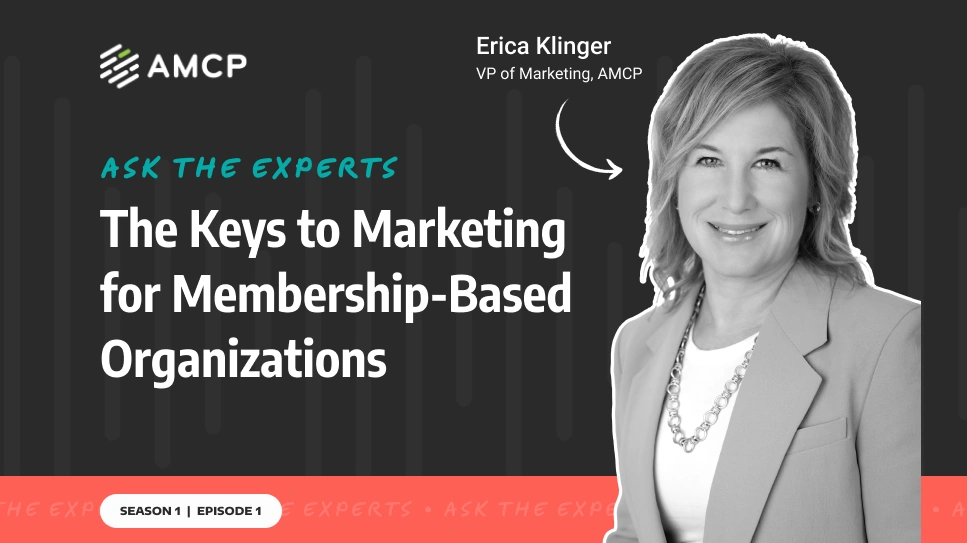
Ask the Expert is a new interview series spotlighting marketing leaders working at the intersection of strategy, execution, and real-world complexity. In each conversation, we sit down with practitioners who are navigating modern marketing challenges inside mission-driven and membership-based organizations and ask them to share what’s actually working, what’s changing, and what deserves a closer look.
We’re excited to launch the series with Erica Klinger, who leads marketing at AMCP and brings more than 15 years of experience across healthcare, advocacy, philanthropy, and professional communities, including St. Jude Children’s Research Hospital. Erica’s path into mission-led marketing was shaped by both professional growth and deeply personal experiences, grounding her perspective in empathy, accountability, and impact.
In this conversation, Erica shares an honest look at the realities of marketing for membership organizations today, from balancing advocacy, education, and retention to using data and AI in ways that strengthen trust rather than erode it. Throughout, she reinforces a simple but powerful idea: effective marketing is not about volume or tactics, it’s about clarity, alignment, and listening at scale.
We’re grateful to Erica for being the first guest in the Ask the Expert series and for setting the tone with such a thoughtful, practical perspective.
Background & Mission
Q: You’ve spent much of your career in mission-driven, membership-based healthcare organizations. What originally drew you to work that sits at the intersection of public health, access, and community?
My career didn’t start in healthcare, it started in new and emerging media. I was drawn to digital because it was creative, fast-moving, and a little unpredictable. I graduated as a fine arts major in graphic design right before the internet really existed, so when digital exploded, it felt like an open frontier. For my first 15 years, startups gave me flexibility to raise my family and the adrenaline rush of building something from nothing.
That path shifted after a major life moment. I survived a near-fatal car accident, and at the same time my sister (just a year older than me) was diagnosed with brain cancer. My rehab was hard, but it was nothing compared to watching her endure treatment and recovery, something she is still fighting 20 years later. It fundamentally changed how I thought about purpose, time, and impact.
When I first moved to Memphis I applied to work at St. Jude Children’s Research Hospital. They weren’t fully ready for digital marketing yet, three years later they called and asked if I would help lead the transition, from traditional fundraising to digital promotion, building and leading a team of digital channel experts (email, SEM/SEO, data analytics, advertising and social media). That role changed everything for me. Working on the hospital campus, meeting patients and families, and seeing the real-world impact of the work made it impossible to ever go back to marketing that was only about revenue or selling a product.
For the first time, my kids understood and were proud of what I did — and that mattered. That was my entry point into healthcare and mission-led work, and 15 years later, I’ve never strayed far from it.
Q: You’ve worked across nonprofits, professional communities, and large national institutions like St. Jude. How did those early experiences shape how you think about purpose-driven marketing today?
They shaped everything.
At St. Jude, building community was deeply personal. We weren’t selling anything. We were sharing patient stories, donor stories, and a collective belief that cancer could be cured. Employees, celebrities, corporate partners, and donors were aligned around the same mission. Marketing was emotional, but it was also incredibly scientific. We tracked everything — cost per donor, channel efficiency, engagement over time — because stewarding donor dollars responsibly was the highest priority.
That balance between emotion and data has stayed with me.
At Seattle Foundation, the mission became hyper-local. Instead of a national audience, the focus was a single community — nonprofits, local businesses, government entities, and philanthropists working together. The work was less transactional and more experiential. It required aligning corporate responsibility goals with long-term community impact. Again, marketing wasn’t about revenue — it was about trust, alignment, and sustained change.
When I moved to DC and into advocacy and pharmacy, the complexity increased again. Advocacy requires education. Healthcare is complicated. You need stories, but you also need data, policy literacy, and alignment across patients, providers, payers, industry, and government. Change doesn’t happen quickly, it takes persistence, consistency, and a strong collective voice.
That’s where I’ve spent the last decade, working at the intersection of access, affordability, and patient impact. And through it all, marketing has remained the same at its core: educate, connect, build trust, and amplify voices that need to be heard.
The Reality of Marketing to Membership-Based Organizations
Q: What do you see as the biggest differences between marketing for membership-based organizations and marketing in more traditional commercial environments?
Honestly, I don’t see as big a difference as people think. Members are still customers. Commercial brands chase loyalty just as much as associations do — whether through subscriptions, rewards, or purpose-driven messaging.
The real difference is the lack of a tangible product. Associations sell advocacy, education, and community — which are harder to explain and harder to quantify and can be hard to optimize in a digital campaign without that perfect “funnel”. You’re asking people to invest in long-term value, shared voice, and collective impact in a world where individuals can curate their own experiences through LinkedIn, conferences, or online learning platforms.
That means association marketing relies heavily on education, storytelling, and showing — not telling — value. Member stories, data, and outcomes matter. Engagement over time matters. Without members, associations lose the insight and credibility needed to drive real change.
Q: Membership organizations are often balancing advocacy, education, and community building at the same time. Where do you see leaders struggling most right now?
Retention.
Members are more data-driven and more selective than ever and attention spans less. They want to understand the value they’re receiving, and associations often struggle to report that clearly. Many are operating with legacy systems, disconnected data, limited eCommerce functionality, business/data intelligence staff and teams that are stretched thin.
Add AI into the mix, and it creates both opportunity and tension — especially when trust, personalization, and data integrity aren’t fully in place yet.
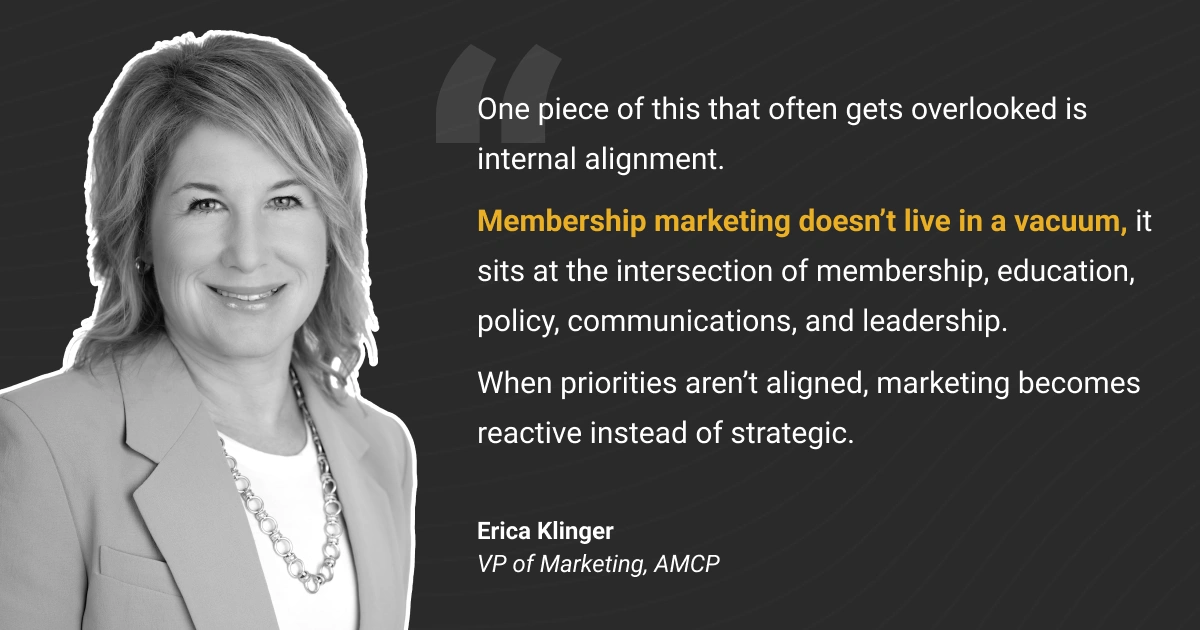
One piece of this that often gets overlooked is internal alignment. Membership marketing doesn’t live in a vacuum, it sits at the intersection of membership, education, policy, communications, and leadership. When priorities aren’t aligned, marketing becomes reactive instead of strategic.
The strongest associations I’ve worked with treat marketing as an orchestrator, not a service desk. Shared goals, shared data, and clear roles matter more than any single campaign or tool. When teams are aligned around outcomes, whether that’s engagement, advocacy momentum, or member growth, the work becomes clearer, more efficient, and ultimately more impactful.
Q: Many membership-based organizations have a strong mission but still struggle to clearly communicate day-to-day value. Where do you see that disconnect most often?
Associations do a lot — sometimes too much to communicate clearly. When messaging becomes broad, overwhelming, or mission-heavy without personalization, people tune out.
Technology and AI can help simplify and personalize — but only if it’s used thoughtfully. The message has to be relevant, timely, and tied to a real problem someone is trying to solve. When budgets are tight, both members and partners are asking hard questions about ROI. Showing how their engagement connects to long-term impact and personal or business growth is critical.
Where Strategy Meets Reality: Execution, Tools, and AI
Q: Membership teams are frequently asked to support many initiatives with limited staff and budgets. How do you decide where marketing effort will have the greatest impact?
It comes down to value and revenue — and the data that connects the two.
Marketing has to grow reach and influence, but it also has to support retention, education, and sales. The only way to make those decisions responsibly is through measurement. Cost per engagement. Cost per member. Cost per attendee. Cost per corporate partner. Then scaling when you can tie engagement to retention and revenue.
That hasn’t changed since my early days at St. Jude. The tools are more advanced now, but the principle is the same: follow the data, stay grounded in purpose, and invest where both align.
Q: How has AI changed the way you and your team think about content, engagement, or operational efficiency over the past few years?
AI is powerful — and risky — especially in mission-driven organizations.
Before engagement or retention, there’s trust — and everything we do either builds it or weakens it.
We’re early adopters because AI can help smaller teams do exponentially more. It’s valuable for operations, creativity, behavior insights and trends, and content creation. But associations are built on trust, relationships, and human stories. If AI removes that humanity, it undermines the mission.
That’s why governance, testing, and transparency matter. A mistargeted message to a longtime member can do real damage. We’re intentional about piloting, using sandboxes, and involving members in the process. AI should support relationships — not replace them.
Q: Where have you seen AI deliver real value for membership organizations, and where do you think a more cautious approach is warranted?
We’ve seen the most immediate value in practical, member-facing and internal use cases — especially chat assistants and AI-powered search on our website. Members come to us with specific questions, and AI helps them get answers faster without adding strain to already lean teams.
Internally, AI has been valuable for building AI marketing agents in Microsoft Copilot. These are tools that help teams ensure content meets brand standards, drafts messaging based on defined personas or voice, and empowers people across the organization to be thoughtful content contributors. That’s critical in associations, where expertise lives everywhere, not just in marketing.
We’ve also seen real impact in using AI to extract insights from unstructured data — things like social comments, survey responses, and community feedback. Without a full-time analyst, there’s simply no way to comb through all of that manually. AI helps us listen at scale.
Where caution is warranted is in delivery, especially when automation touches members directly. Data integrity and governance has to come first. Transactional or high-level messages are easier to automate, but anything nuanced like storytelling, legislative impact or patient-focused messaging carries risk if it’s not handled carefully. In healthcare and advocacy, getting the details right isn’t optional.
Q: What role does data play in guiding decisions when success is measured in engagement, retention, or impact rather than direct revenue?
It’s not just about the data… it’s about the insights and actions that come from it.
Dashboards can show trends year over year and highlight which campaigns or messages are performing well. But the real power of data is in revealing friction points and opportunities to improve the member/customer experience.
For example, if people repeatedly ask the same question through a website chat assistant and can’t find the answer, that’s a signal to create or improve content. If users drop off after the first 10 seconds of a video, or abandon the membership sign-up process midway through, analytics are telling you something important — without anyone having to tell you.
At a higher level, data helps reduce barriers across the digital experience and shows whether messages are actually resonating with the community. Social media, in particular, is a powerful listening tool. When you pay attention to what members are saying — and act on it — you strengthen trust, improve retention, and create the conditions for stronger partnerships and sustainable revenue.
Impact doesn’t always show up immediately in dollars, but it shows up clearly when you’re truly listening.
Perspective & Advice
Q: What’s something you wish more people understood about the complexity of marketing within membership-based organizations?
That it’s not simpler than corporate marketing — it’s more nuanced. You’re balancing mission, business, advocacy, community, and trust often with fewer resources and higher expectations.
The expectations of marketing leadership inside associations have fundamentally changed. Marketing is no longer just about promotion or communications — it is now instrumental in experience, data, voice, and growth. That means understanding member behavior, translating complex issues into clear narratives, and helping the organization make smarter, faster decisions.
For leaders, this requires a shift in mindset. Marketing works best when it’s involved early in shaping priorities, not just executing them. When marketing is positioned as a strategic partner, it becomes a driver of alignment, trust, and long-term value for both members and the organization.
Q: For marketers considering a move into a membership-driven or mission-led organization, what advice would you give them before making the leap?
If you want fast wins and transactional success, this might not be the path. But if you care about long-term impact, storytelling, and fighting for people who don’t always have a voice, it’s incredibly meaningful work.
I’m passionate about health because I’m fortunate. I can be outdoors, paddle, hike, bike, and ski. Marketing in healthcare is a responsibility — to fight for access, affordability, and outcomes for those who can’t. If health care or another mission motivates you, the work is worth it.

With over a decade of agency and in-house experience, Ben Huizinga is a creative and brand strategist focused on building brands that endure—crafting identities that make meaningful connections and stand the test of time. As Director of Brand and Creative at Young Marketing Consulting, Ben blends hands-on execution with high-level strategic thinking, helping organizations align their vision with the right voice, visuals, and experiences. He is also an experienced website architect, specializing in the development of beautiful, easy-to-use WordPress, Drupal, and Webflow sites that bring brands to life online. His work has shaped leading brands across the sustainability, technology, and nonprofit sectors—including Geothermal Rising, Echo Communications, and Bonterra, one of the world’s largest social good technology companies.
You might also be interested in these related articles:
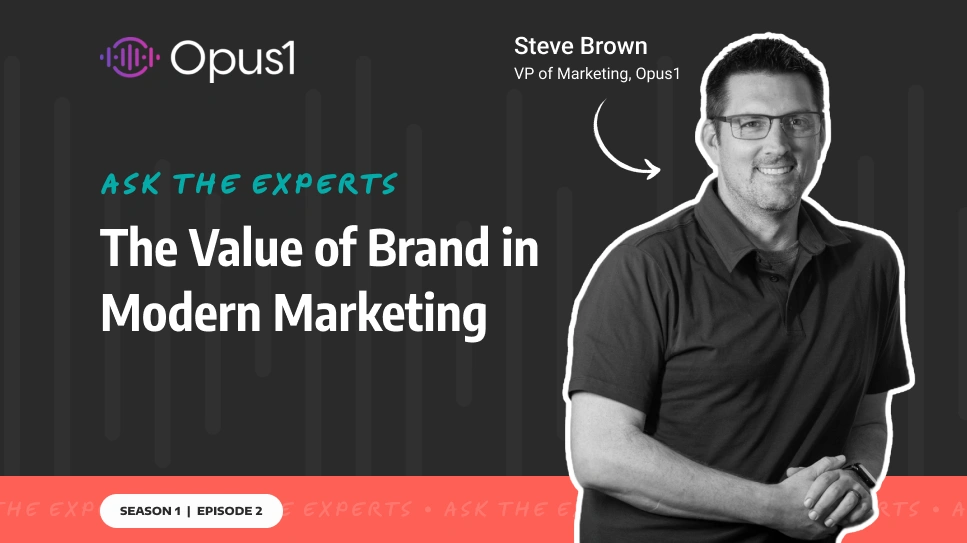
Ask the Expert is a new interview series spotlighting marketing leaders navigating mission-driven and membership-based organizations. In this second episode we hear from Steve Brown on the value of brand in modern marketing.